
 Spanish
 English
 Italian
 Portuguese
 French
Welcome to Our Blog - ITG Group
Blog
- Technical
- Sep 08, 2026
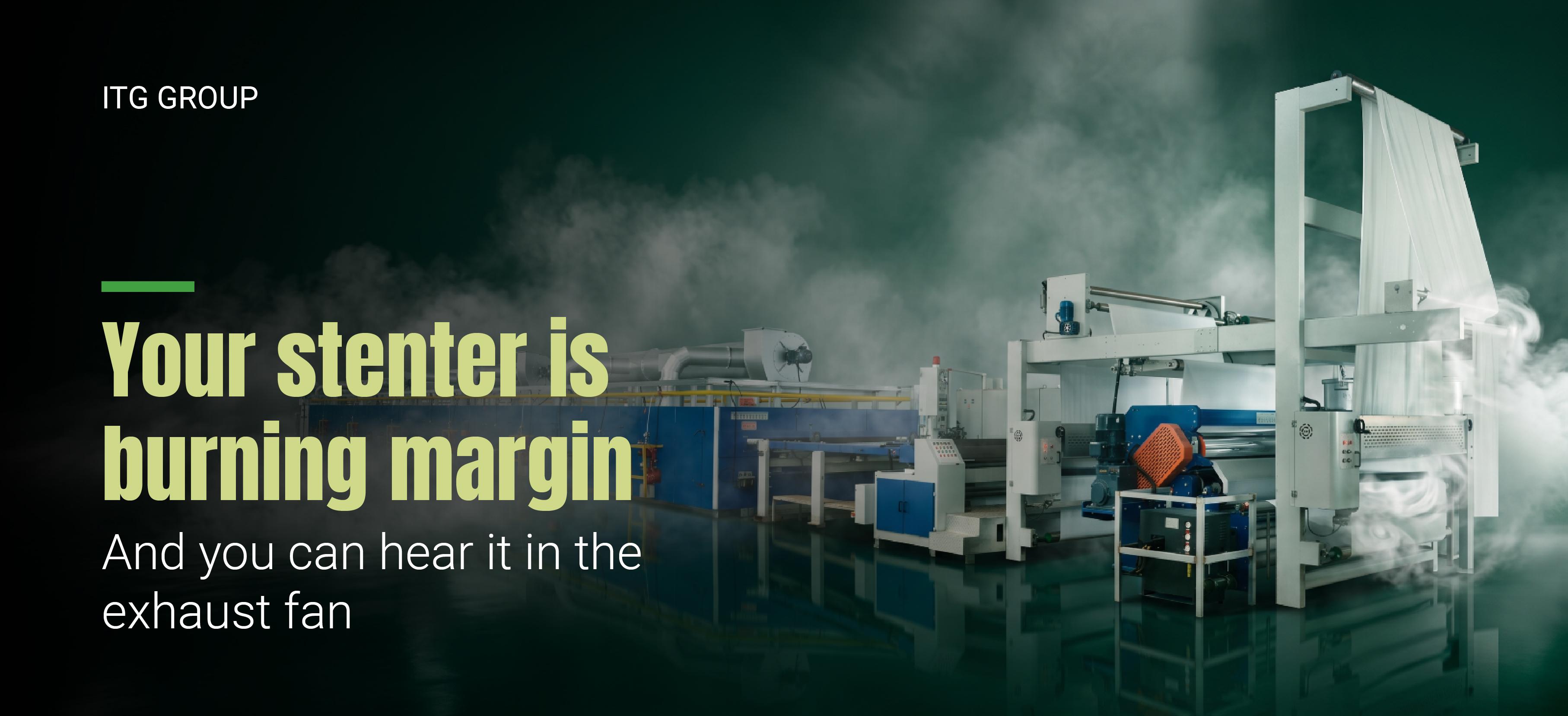
Your stenter is burning margin — and you can hear it in the exhaust fan
If you run a finishing line, you already know which machine you'd check first if the energy bill jumped: the stenter.
It's usually the single largest thermal energy consumer on the floor, and the reason is simple physics — you're pushing wet fabric through chambers of hot circulating air, and generating that heat, chamber after chamber, shift after shift, is expensive. The literature is blunt about it: the stenter is described as one of the most thermal-energy-consuming machines in the entire textile process, and finishing together with wet-processing preparation accounts for roughly 35% of a composite mill's thermal energy.
Here's the part that doesn't show up on a gauge: a large share of that energy never touches your fabric. It leaves through the exhaust stack as hot air, radiates into the workshop, or gets wasted holding temperature the process didn't need. That's not a dramatic failure. It's a quiet, continuous leak — and it's paid for in every meter of fabric you run.
This article breaks down where a conventional stenter loses energy, and how the design of our XY-D-2600 Stenter Machine attacks each loss at the source.
Where a conventional stenter loses energy
Three losses account for most of the waste, and they compound.
Hot exhaust air, thrown away. A stenter continuously vents humid, hot air to keep the chamber atmosphere right for drying. In a conventional setup, that exhaust — carrying real thermal energy you already paid to generate — goes straight up the stack. Research on stenter energy flows identifies exhaust gas as one of the single biggest bottlenecks to efficiency, and studies on waste-heat recovery from stenters have demonstrated fuel-consumption reductions above 60% when that exhaust heat is properly captured and reused. Every degree in that vented air is money spent once and lost.
Thermal leakage and radiation. Heat doesn't stay politely inside the chambers. It escapes through panel walls, gaps and poorly insulated surfaces — which is why the area around an older stenter is often uncomfortably hot. That radiated heat is doubly costly: it's energy that left the process, and it raises the workshop temperature, which your ventilation then has to fight.
Temperature and airflow you can't control precisely. When you can't independently regulate conditions across the machine — top versus bottom, section by section — you compensate by overshooting. You run hotter or push more air than the fabric strictly needs, just to hold quality. That safety margin is real fabric quality insurance, but it's also continuous over-consumption. And atmospheric conditions make it worse: energy-model studies show stenter performance can swing by up to 10% of total energy required just from seasonal changes in ambient air temperature and humidity.
How the XY-D-2600 attacks each loss
The XY-D-2600 Stenter Machine is a double-layer stenter built specifically around energy consumption. Three design features map directly onto the three losses above.
1. Double-layer oven — reusing heat instead of regenerating it. This is the core idea. The oven is stacked in two layers, and the heat generated in the first heat-setting layer is transferred to the second layer through a closed iron plate. Instead of every chamber generating its own heat from zero, the second layer runs partly on heat the first layer already produced. Per the catalog, that recovery is worth about 20%–40% energy saving, depending on the process. And because the layers are stacked, each cabinet is 1600 mm high — you get that saving without doubling your floor area.
2. Waste-heat recovery — preheating fresh air with air you were going to vent. The second attack is on that exhaust stack. A stenter constantly needs to replenish fresh air into the oven. In the XY-D-2600, that incoming fresh air is routed through the waste-heat recovery device first — so it's preheated by the outgoing exhaust before it enters the chamber. You're recovering energy from the exact air you were about to throw away. The catalog puts this at roughly 10%–30% energy saving. The exhaust and supplementary fans are both frequency-controlled, and the system reports a 2%–3% production-efficiency gain on the same line, depending on process conditions. The insulation backs it up: panels are galvanized plate with 150 mm of high-quality insulation material to shut down the heat leakage described earlier.
3. Independent dual air ducts — precision instead of overshoot. The third feature solves the over-consumption problem. The XY-D-2600 uses two independent air ducts, with upper and lower air volume controlled separately and settable to any ratio through the menu, regulated by frequency converters. That means you stop compensating with blanket overshoot and start matching airflow to what the fabric actually needs, top and bottom. Critically, this holds even at low speed — which is exactly where sensitive fabrics live. The catalog specifies stable fabric results at any speed for knitwear, coated fabric, recycled fabric, ultra-fine fiber, plush and silk. Lower, precise airflow on delicate goods is both an energy saving and a quality safeguard at once.
What this means on the bill — and in the fabric
The savings percentages above aren't marketing rounding — they're catalog figures tied to process conditions, and they stack on the machine that's already your biggest energy line. When your single largest thermal consumer runs 20%–40% more efficiently in the oven and recovers another 10%–30% from exhaust, that isn't a rounding error on the energy bill. It's a structural change to your cost per meter — the kind that compounds every shift, every day, for the life of the machine.
Independent industry work points the same way: waste-heat recovery projects on stenters have reported 20%–30% savings in electricity and fuel, and broader stenter modernization is credited with cutting specific energy consumption by 10%–25%. We're not going to hand you an ROI figure — that depends on your energy price, your fabric mix and your run hours, and anyone who quotes you a universal payback is guessing. But the direction is not in question, and the inputs to calculate your own are all here.
And the quality side matters just as much, because energy efficiency that costs you fabric quality isn't efficiency. The same features that save energy — precise dual-duct airflow, heated fresh air fed in to avoid large temperature differentials and dripping, stable conditions at low speed — are the features that protect hand feel and finish consistency on sensitive fabrics. On a stenter, done right, the energy decision and the quality decision are the same decision.
Where ITG Group fits
ITG Group supplies the XY-D-2600 double-layer stenter, and our role doesn't end at the purchase order. Sizing a stenter to your line — chamber count, working width, heat source, the fabrics you actually run — is a technical conversation, not a catalog pick. If your current stenter is running hot, venting heat into the workshop, or forcing you to overshoot temperature to hold quality, those are the symptoms worth evaluating.
Tell us what you're finishing and the conditions you're running, and our technical team will work through the configuration with you — including an honest read on whether the numbers justify the change for your specific operation.
Get in touch: info@group-itg.com
- Technical
- Aug 03, 2026
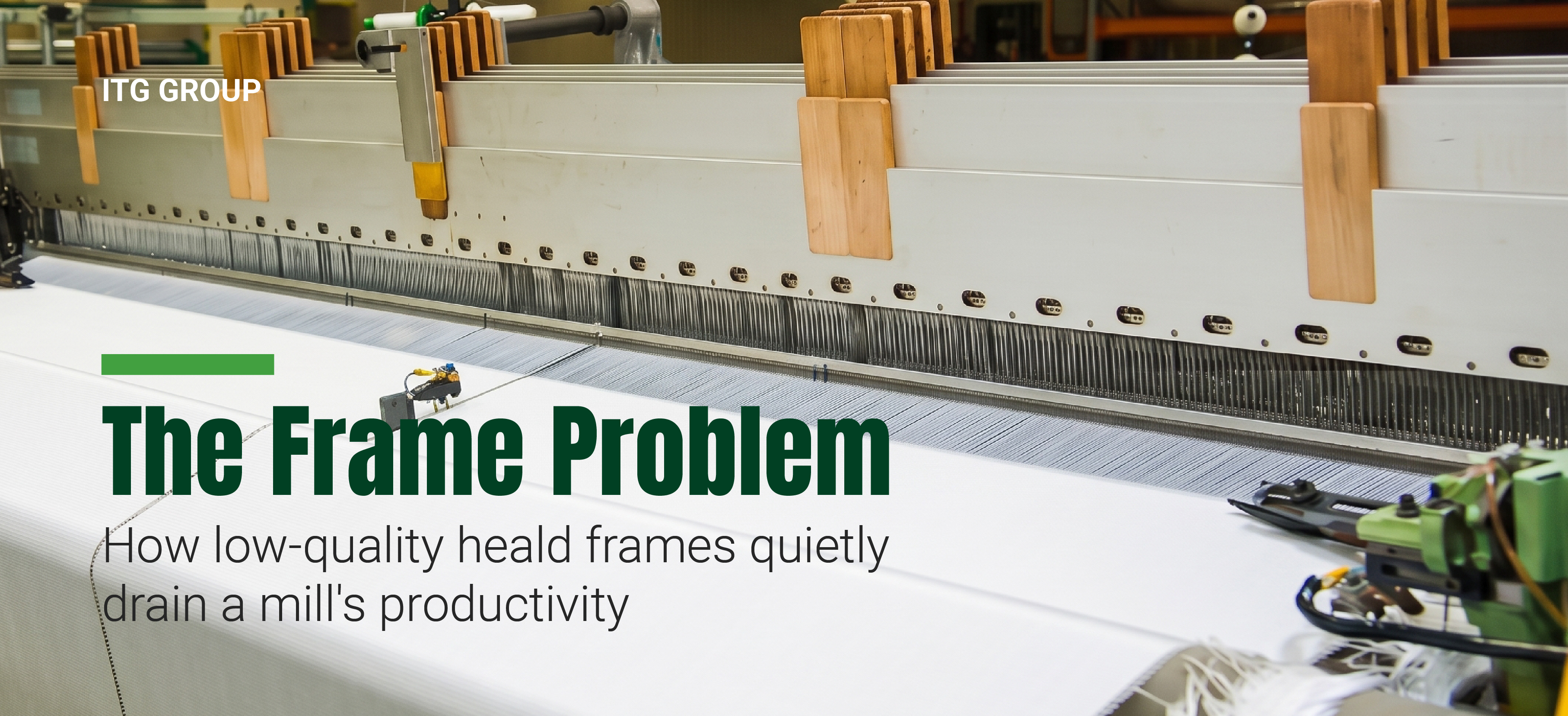
The Frame Problem: How Low-Quality Heald Frames Quietly Drain a Mill's Productivity
Ask any weaving manager what stops their looms, and you'll hear about yarn quality, humidity, machine age. What you'll rarely hear about is the component doing millions of movement cycles right in the middle of it all: the heald frame.
That's a blind spot — because the numbers say frames deserve far more attention than they get.
A study of loom stoppages in an air-jet weaving mill found that 58% of all stops were caused by warp breakages — by far the largest category, ahead of weft breaks (34%) and everything else combined (8%). And here's the detail that matters for this article: where the warp breaks determines how long the loom stays down. A break near the reed can be repaired with a quick knot. A break in the heald and drop wire zone takes significantly longer — the weaver has to identify the affected heald wire, rethread the yarn, and restart.
The same body of research puts the average warp break repair at around 2.87 minutes. That sounds small — until you multiply it across every loom, every shift, every day. A mill running dozens of looms with an elevated warp break rate is losing full production hours daily, one "small" stop at a time.
The heald frame endures millions of high-speed movement cycles, constantly interacting with heald wires and bearing tension from the warp. Research on heald frame design identifies it as one of the loom components most responsible for vibration and noise — and vibration is precisely what limits high-speed performance.
When a frame is poorly built or worn, the chain reaction looks like this:
1. Excess vibration transfers stress to the warp yarns on every shedding cycle.
2. Stressed yarns break more often — feeding that 58% category of stops.
3. Worn or misaligned frames force mills to reduce loom speed just to keep running.
4. Frames that can't hold up wear out faster, doubling replacement frequency — and doubling the downtime each replacement requires.
Industry analysis of weaving components is blunt about it: a poor-quality or worn heald frame doesn't just reduce weaving speed — it causes warp thread breakage, creates defects on the fabric surface, and increases maintenance costs simultaneously.
Every unplanned stop carries three costs at once: lost production, idle labor, and quality risk. That last one is the most underestimated — loom stoppages don't just pause output, they leave startup marks and differential dye take-up woven into the fabric as visible defects. The stop ends; the defect ships.
Industry benchmarks target under 10% total downtime for efficient weaving production. A mill whose frames are quietly inflating its warp break rate can blow through that threshold without a single "major" breakdown ever appearing in the maintenance log.
When a mill audits its downtime, the heald frame rarely gets a line item — the stops get attributed to "warp breaks" and the analysis ends there. But if warp breaks are your biggest stop category, the components touching those yarns thousands of times per minute deserve to be your first inspection point, not your last.
A frame is not a commodity. At production speed, it's the difference between a loom that runs and a loom that stops.
At ITG Group, our heald frames for high-speed air-jet looms are engineered for exactly this: durability, reduced maintenance costs, and stable performance up to 1000 RPM, compatible with Picanol, Toyota and Tsudakoma looms. If recurring stops are eating your production hours, our technical team can help you evaluate whether your frames are part of the problem.
Sources: Austin Journal of Textile Engineering (loom stoppage study); research on heald shaft design and vibration (composite heald frame studies); VieTextile component selection analysis; Textile School downtime benchmarks.
- Technical
- Jun 09, 2026
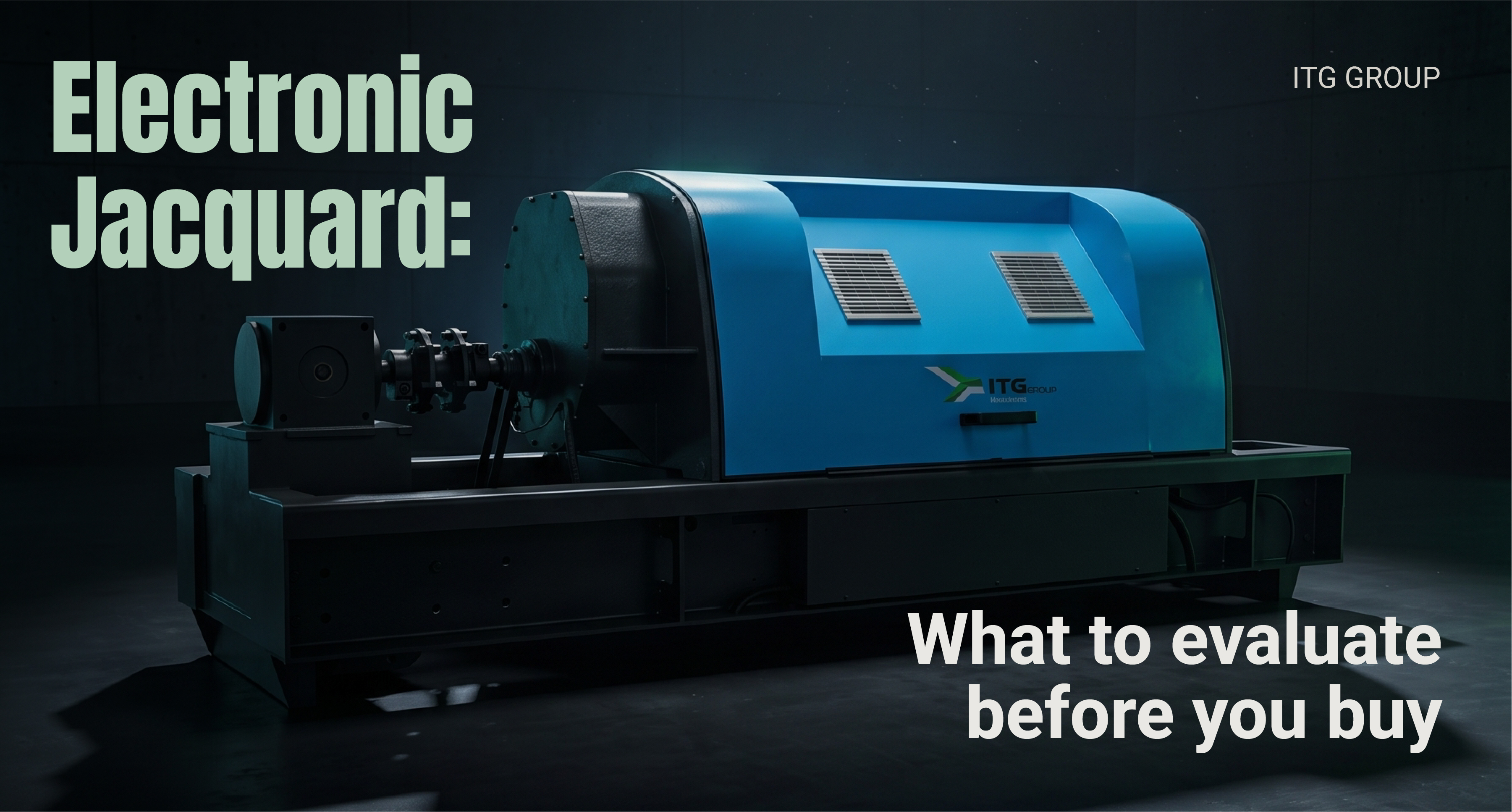
Electronic Jacquard: What to Evaluate Before You Buy
Specifying an electronic jacquard system isn't a straightforward purchase decision. Two systems can share the same hook count, run on the same loom, and produce the same fabric — and still deliver completely different results in daily production. The difference lies in four technical parameters that most spec sheets don't put front and center: drive mechanism, controller architecture, shedding geometry, and compatibility envelope.
Drive mechanism
The drive system is the most consequential technical decision in a jacquard specification. It directly determines maximum operating speed, vibration profile, maintenance intervals, and the types of fabric the system can reliably produce.
Bilateral eccentric cam — This is the highest-performance drive architecture currently available in electronic jacquard. The cam acts on both sides of the mechanism simultaneously, distributing load symmetrically and eliminating the unbalanced forces that cause vibration at high speeds. The result is stable operation at up to 650 RPM — the threshold at which most double-chain or gear systems begin to degrade in consistency. For mills running air jet or high-speed rapier looms, this is the only drive type that keeps pace without compromising shed quality.
Double chain system — A proven architecture for medium-speed environments, the double chain delivers reliable double-lift full-shedding performance at up to 300 RPM. Its mechanical simplicity translates to fewer failure points and predictable maintenance cycles. The trade-off is an upper speed ceiling that makes it unsuitable for high-speed shuttleless looms running above that threshold.
Gear drive — The most mechanically straightforward of the three, gear transmission is optimized for low-speed operation up to 250 RPM. Its compact footprint makes it the practical choice for mills with constrained floor space or lower production volumes. Three shedding types are supported — 95/95, 115/115, and 95/115 — giving it more shedding geometry flexibility than its speed range might suggest.
Controller architecture
Speed and mechanical stability determine the ceiling of what a jacquard system can do. The controller determines how much of that ceiling you actually use in daily production.
The shift from proprietary industrial controllers to Windows-based systems with optical transmission and dual-core processing has fundamentally changed two things: design changeover time and fault resolution speed.
Design changeover. A Windows-based controller running EP and JC programs natively means new patterns load directly from standard design software without format conversion or reprogramming. For mills running short production runs or managing multiple buyers with different specifications, this directly impacts how many articles a loom can produce per shift.
Fault diagnosis. Dual-core processing enables real-time monitoring of needle-selecting performance, shed formation consistency, and drive system status simultaneously. When a fault occurs, the system can isolate the cause and display it immediately rather than requiring manual inspection across mechanical components. In practice, this means the difference between a 10-minute intervention and a two-hour troubleshooting process.
Anti-interference performance. In multi-machine environments — which describes most production mills — electromagnetic interference between looms is a real operational variable. Industrial-grade controller systems with dedicated anti-interference transmission architecture maintain signal integrity across the full hook array even when adjacent machines are running at full speed.
Shedding geometry
Shedding size — the distance between open and closed shed positions — is rarely the first number buyers look at, but it has direct consequences for warp tension management and fabric quality consistency.
The 50–120mm shedding size range supported by bilateral eccentric cam and double-chain systems covers virtually the full spectrum of flat fabric production: home textiles, garment fabric, towels, ties, and technical fabrics. The adjustment mechanism matters as much as the range: a fast, simple knife height-adjustment system and quick opening dimension-adjustment system allow operators to optimize shed geometry for each article without extended downtime between changeovers.
For gear-drive systems, shedding sizes of 95/95, 115/115, and 95/115 provide a defined but sufficient range for the fabric types these systems are designed to produce — primarily flat fabrics, terry cloth, and label applications on low-speed rapier and shuttle looms
Compatibility: mounting a jacquard on your existing loom
The commercial case for electronic jacquard in mid-sized mills often rests on the ability to add capability to existing machinery rather than replacing it. That requires honest compatibility assessment across three variables.
Loom type. Bilateral eccentric cam systems are compatible with rapier, air jet, water jet, and shuttle looms — a full compatibility envelope. Double-chain systems are designed for rapier and shuttle looms. Gear-drive systems target low-speed rapier and shuttle configurations specifically.
Operating speed. The jacquard system's maximum RPM must match or exceed the loom's operating speed. Installing a 300 RPM-rated double-chain system on a loom running at 450 RPM will produce inconsistent shed formation and accelerated mechanical wear — two outcomes that eliminate any production efficiency gains.
Hook count relative to fabric width and pattern complexity. Hook count determines the maximum pattern resolution available at a given reed width. A system with insufficient hooks for the intended fabric width produces visible pattern repeat limitations regardless of how capable the controller is. The range from 480 to 15,360 hooks across the ITG Group line covers single-width label production through wide-width complex jacquard for upholstery and automotive applications.
Market context and ROI
The global jacquard fabric market was valued at $3.45 billion USD in 2024 and is projected to reach $5.67 billion USD by 2033, growing at a CAGR of 6.5%. That growth is distributed across fashion, home textiles, automotive interiors, and technical fabrics — meaning jacquard-capable mills have multiple end markets to address from a single capital investment. Verified Market Reports
Electronic jacquard adoption is accelerating across mid-scale mills, democratizing complex pattern production previously limited to premium heritage manufacturers. The economics are straightforward: jacquard fabric commands a price per meter that plain equivalents cannot reach using the same loom and labor. Mills implementing digital jacquard systems report reduced downtime, lower maintenance costs, and increased production yields compared to older technologies. OpenPRTextile School
The honest qualification: the return is proportional to the mill's ability to access buyers who pay for design complexity. The machine enables the margin — it doesn't create the commercial relationship.
ITG Group's solution
ITG Group offers the GE/GES, DL/DLS, and GYJ families, each matched to a specific operational profile.
The GE/GES runs up to 650 RPM on a bilateral eccentric cam drive with a Windows-based controller, optical transmission, and dual-core processing. Compatible with rapier, air jet, water jet, and shuttle looms. Available from 1,824 to 15,360 hooks. The right specification for high-speed mills producing complex articles across wide widths.
The DL/DLS runs up to 300 RPM on a double chain drive with an industrial-grade anti-interference controller. Designed for rapier and shuttle looms in stable medium-speed production environments. Available from 1,408 to 2,816 hooks.
The GYJ runs up to 250 RPM on a gear drive with a compact frame built for space-constrained factories. Supports three shedding geometries. Available from 480 to 6,912 hooks. The most accessible entry point into electronic jacquard production without sacrificing core design capability.
All three systems support EP and JC design programs, feature tool-free shed opening adjustment, and include fast-diagnostic controllers for minimal downtime during fault resolution.
If you're evaluating jacquard compatibility with your current loom configuration, ITG Group's technical team can assess your specific setup and recommend the right system. The analysis starts with what you already have.
Sources: Verified Market Reports, DataHorizzon Research, Textile School.